A Maturity Model for AI Transformation: Guidance Instead of Evaluation
Jul 08, 2026
Some time ago, I was given the task of supporting the AI transformation in an IT division. The background was quite fundamental: AI is now changing work, value creation, and roles so noticeably that it’s important not to leave this development to chance, but to actively shape the change. There was also the desire to translate the overarching strategic AI ambitions into the lived practice of the division, which has a very wide variety of roles, from engineering and communication to sales and assistance. It’s hardly surprising that such an assignment seems broad and open at the beginning. My first question therefore concerned less the technology than the system behind it: How do you actually structure such a change? Which measures interlock, and at what point do you start without overwhelming the organization right away?
From a systemic perspective, there are good reasons not to think of a transformation as a roadmap imposed from the outside. It often becomes more effective when a system begins to observe itself and talk about itself. For this, however, it also needs a shared language and a shared model that stimulates reflection and highlights fields of action. This led to the creation of a maturity model tailored precisely to the dimensions that matter in AI transformation: as a map and an instrument for starting conversations with one another.
More than counting tools
AI maturity can rarely be reduced to the question of which tools a team uses. Anyone who looks only at tools easily overlooks that technology without strategy, without competence, and without responsible guardrails often has little impact. That’s why the model is deliberately systemic and holistic. It considers five dimensions that together form a picture. It makes visible where a team is in balance and where individual dimensions are racing ahead of the rest or lagging behind.
The five dimensions
Strategy & Portfolio describes how strongly AI initiatives are interwoven with the goals of the team and the organization. The spectrum ranges from individual, unmanaged experiments to the point where AI becomes the central driver of strategy and even sparks new product ideas.
Platform & Tooling asks about access to AI tools and their standardization. This can range from occasionally used, non-approved tools to a company-wide infrastructure that consistently supports AI initiatives.
Delivery & Automation looks at how deeply AI is embedded in actual workflows. Here the spectrum ranges from manual one-off attempts through firmly embedded workflows to largely automated, AI-supported service delivery.
People & Culture focuses on confidence, skills, and the learning culture around AI. It’s about the journey from uncertainty and lack of capabilities, through lived curiosity, to AI fluency, where teams proactively rethink how they work.
Risk & Responsible AI describes governance, policies, and compliance. This ranges from “There are no rules” to responsible principles that are deeply embedded in processes and decisions.
Five stages as orientation
Each dimension can be mapped along five maturity stages: Ad-Hoc (isolated experiments without structure), Exploring (initial pilots, growing curiosity), Repeatable (established methods and workflows, initial guardrails), Scaled (cross-team automation, managed portfolio, integrated platforms), and AI First (AI shapes the strategy, high level of competence, responsible AI is a given).
One point is particularly important to me. The levels are hardly to be understood as a rating from “bad” to “good.” There can be good reasons why a team consciously does not aim for “AI First” in certain dimensions. The model makes fields of action visible while leaving open how a team tackles them in concrete terms. It helps with the questions “Where are we now?” and “Where do we want to go?” The “How do we get there?” remains the responsibility of the team. This openness is part of the design because it invites reflection instead of prescribing recipes.
Simple enough to work directly in a workshop
The real charm of the model reveals itself when you use it as a coaching tool directly in a workshop. It is simple enough that a team can understand it without a long introduction and apply it immediately.
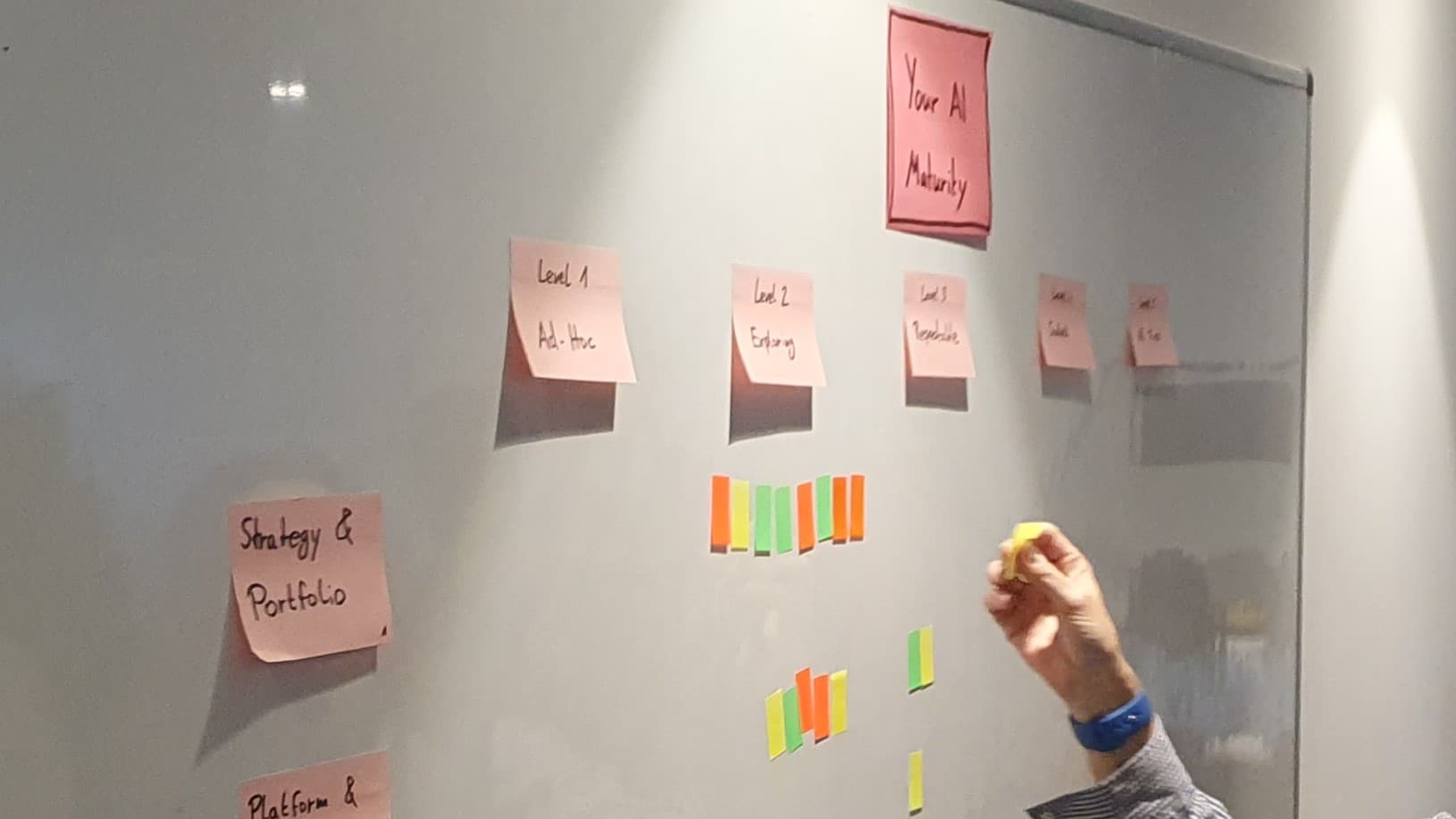
In practice, it often works like this: the five dimensions with their levels are displayed as a matrix on a board, and participants position themselves via dot voting where they see their team today. Within a few minutes, a visible snapshot of the mood emerges, including the interesting moments when the dots are far apart.
For sticking dots to turn into real insight, you need the right reflection questions. For example: What guided you in your assessment? Where do we differ more widely, and what could be the reason? Which dimension is currently slowing us down the most? And where would a single step forward benefit us the most?
Beyond the workshop
What works in the room as dot voting can just as easily be used as an online survey. This allows you to carry out the measurement across the entire organization and gather insights without elaborate workshops. A subsequent measurement enables a status check under the same conditions, so you can see whether anything has changed.
A maturity model does not relieve anyone of the need to develop a strategy or to implement it. But it does create the framework within which both can be negotiated in the first place. In this sense, it works more like a mirror that a team holds up to itself, and that, precisely, can set surprisingly much in motion.
This text was created with the support of artificial intelligence.

%22%2F%3E%0A%20%20%20%20%20%20%3Cstop%20offset%3D%22100%25%22%20stop-color%3D%22hsl(23%2073%25%2023%25)%22%2F%3E%0A%20%20%20%20%3C%2FlinearGradient%3E%0A%20%20%20%20%3CradialGradient%20id%3D%22wash%22%20cx%3D%2250%25%22%20cy%3D%2250%25%22%20r%3D%2250%25%22%3E%0A%20%20%20%20%20%20%3Cstop%20offset%3D%220%25%22%20stop-color%3D%22hsl(175%2075%25%2050%25)%22%20stop-opacity%3D%220.95%22%2F%3E%0A%20%20%20%20%20%20%3Cstop%20offset%3D%22100%25%22%20stop-color%3D%22hsl(175%2075%25%2050%25)%22%20stop-opacity%3D%220%22%2F%3E%0A%20%20%20%20%3C%2FradialGradient%3E%0A%20%20%20%20%3Cpattern%20id%3D%22stripes%22%20width%3D%2261%22%20height%3D%2261%22%20patternUnits%3D%22userSpaceOnUse%22%20patternTransform%3D%22rotate(10)%22%3E%0A%20%20%20%20%20%20%3Cpath%20d%3D%22M%200%2030%20L%2061%2030%22%20stroke%3D%22white%22%20stroke-opacity%3D%220.09%22%20stroke-width%3D%221.8%22%2F%3E%0A%20%20%20%20%3C%2Fpattern%3E%0A%20%20%3C%2Fdefs%3E%0A%0A%20%20%3Crect%20width%3D%221600%22%20height%3D%22900%22%20fill%3D%22url(%23bg)%22%2F%3E%0A%20%20%3Crect%20width%3D%221600%22%20height%3D%22900%22%20fill%3D%22url(%23wash)%22%20opacity%3D%220.28%22%2F%3E%0A%20%20%3Crect%20width%3D%221600%22%20height%3D%22900%22%20fill%3D%22url(%23stripes)%22%2F%3E%0A%0A%20%20%3Cg%20fill%3D%22none%22%20stroke%3D%22white%22%20stroke-opacity%3D%220.10%22%3E%0A%20%20%20%20%3Cpath%20d%3D%22M%200%20739%20C%20260%20569%2C%20570%20909%2C%20840%20739%20S%201300%20569%2C%201600%20739%22%20stroke-width%3D%222%22%2F%3E%0A%20%20%20%20%3Cpath%20d%3D%22M%200%20807%20C%20220%20642%2C%20610%20972%2C%20910%20807%20S%201320%20642%2C%201600%20807%22%20stroke-width%3D%222%22%2F%3E%0A%20%20%3C%2Fg%3E%0A%3C%2Fsvg%3E)